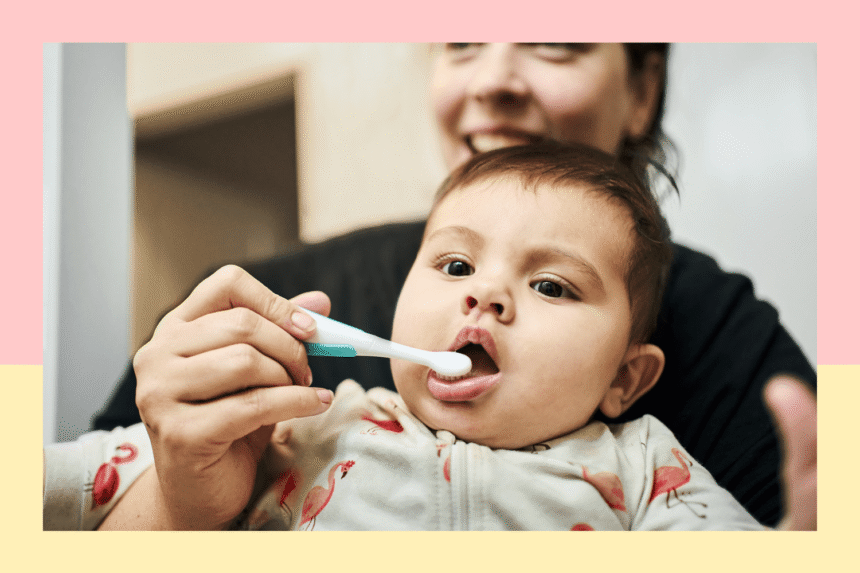
If you’re wondering when to start brushing your baby’s teeth, you’re not alone. Almost every new parent wonders what to do about their baby’s budding pearly whites. But the truth is, it’s never too early to start maintaining your baby’s oral health.
We consulted several experts who point out that the health of your baby’s gums is just as important as their teeth, especially since baby teeth are already forming and waiting to emerge under the gums.
So, if you haven’t started yet, you can gently clean your gums after meals, even if you don’t have teeth yet. Here’s how pediatric dentists and other professionals recommend caring for those tiny little teeth that protrude through the gums, starting in your baby’s first few months of life.
How early can I brush my baby’s teeth?
It is important to start brushing your baby’s teeth and mouth early. Although your baby’s primary teeth, or “baby teeth,” are not a permanent part of the smile, they still play an important role. Not only does it help your child speak clearly and chew properly, it also creates a pathway for permanent teeth to emerge.
Even before pearly whites appear, you may want to get your baby used to cleaning his mouth with a wet rag or gauze, says Sonia Gutierrez Ismail, DDS, a pediatric dentist and owner of Kids Dentist in Grayslake, Illinois. “And as soon as the first tooth comes in, you start using the toothbrush very gently to keep those teeth clean.”
Your baby’s first tooth can be expected to appear between the ages of 3 months and 1 year. However, most babies get their first tooth between 6 and 10 months of age. By the time your child is about 33 months old, or about 3 years old, he or she will likely have all 20 primary teeth.
Choosing the right toothbrush and toothpaste
Even before your baby has teeth, you can start by cleaning their mouth with gauze or a washcloth after meals, says Dr. Shiri Greenberg, Clinical Director of Pediatric Dentistry at Touro School of Dentistry. “This also helps start your child on the path to a lifetime of good oral health.”
Once teeth emerge, a finger toothbrush is a great option, adds Greenberg. “Then you can move on to a soft-bristled brush with a smaller head, preferably one designed for young children.”
Gutierrez-Ismail suggests looking for a brush with soft bristles that is appropriate for your child’s age, adding that it’s important to avoid textures that are too harsh or too hard.
Jonelle Anamelechi, DDS, MS, pediatric dentist and owner of Children’s Choice Pediatric Dentistry and Orthodontics, recommends surround toothbrushes. “It has bristles on all sides, so it’s very effective on frizzy brush. As a mom dentist, I also use it on my older kids (6 and 9 years old). It comes in infant and toddler sizes, as well as sizes for older kids.”
What about toothpaste?
The appropriate amount of toothpaste depends on the age of your baby. “Toothpaste is not necessary until the child is about one year old,” says Gutierrez Ismail. “At 1 year old, you can introduce toothpaste that is smaller than a grain of rice. At about 2 years old, you can step it up a little and make it the size of a grain of rice.”
Even for children 6 to 8 years old, the maximum amount of toothpaste should be pea-sized.
It’s important to teach children to spit when brushing their teeth, but this skill can be difficult to master, Gutierrez-Ismail points out. “Children usually don’t learn to spit until they’re three or four years old, so we recommend a very small amount of toothpaste.” However, it’s still important to use toothpaste because it contains ingredients that help remove plaque and fight bacteria.
Expert opinion on fluoridated toothpaste
According to the American Academy of Pediatric Dentistry, parents are encouraged to apply fluoride toothpaste to their baby’s teeth. This differs from a recent study from the U.S. Centers for Disease Control and Prevention. The authors recommend waiting to introduce fluoride toothpaste until the child is 2 years old.
Consult your health care provider to determine what is appropriate for your child, and also be aware of whether your city’s drinking water contains fluoride.
How to brush your baby’s teeth
The process of brushing your baby’s teeth can feel overwhelming, especially if it’s your first time. The important thing is to do it slowly, gently, and happily. Anamelechi offers the following step-by-step guide to make brushing a little easier. Once you get the hang of it, it should become part of your daily routine.
- Wet your toothbrush.
- Moisten your toothbrush with a little water to soften the bristles.
- Apply toothpaste.
- Apply a small amount of fluoride toothpaste to your toothbrush. (Children under 3 years old use a small smear; children 3 to 6 years old use a pea-sized amount.)
- Start brushing gently.
- Hold the toothbrush at a 45-degree angle to your baby’s gums.
- Use small, gentle circles to clean the front, back, and chewing surfaces of all teeth.
- Brush for 2 minutes, or about 5 seconds per tooth for children with fewer than 20 teeth.
- Set a timer or sing a short song twice to help with timing.
- Spit out the toothpaste, but do not rinse it off with water. Anamerech says this will ensure that the fluoride continues to protect the baby’s teeth.
- Rinse your toothbrush with water and let it stand upright to dry naturally.
Other important tips
Remember that brushing your teeth is not the only dental maintenance. Keep these other tips in mind:
- Replace your toothbrush every three months if the bristles are worn.
- Once your child’s teeth touch, experts recommend flossing to keep the gums healthy.
when should you go to the dentist
The American Academy of Pediatric Dentistry recommends establishing a dental clinic by 12 months of age. “This provides an important opportunity to discuss and implement preventive measures to reduce your child’s risk of developing preventable dental and oral diseases,” says Greenberg.
During these visits, the pediatric dentist will perform a clinical exam and discuss topics such as brushing teeth and weaning the baby from the bottle, she says. They may also talk about age-appropriate times to stop using pacifiers or thumb sucking, and discuss diet and nutrition, she says. During this time, you can ask questions about teething pain, injury prevention, swallowing issues, and any other concerns you may have.
“The pediatric dentist will also discuss your child’s (tooth decay) risk and provide counseling regarding your child’s fluoride exposure, such as drinking optimally fluoridated water,” says Greenberg. “The pediatric dental home should be a comfortable place where parents and children feel free to ask questions and receive care.”