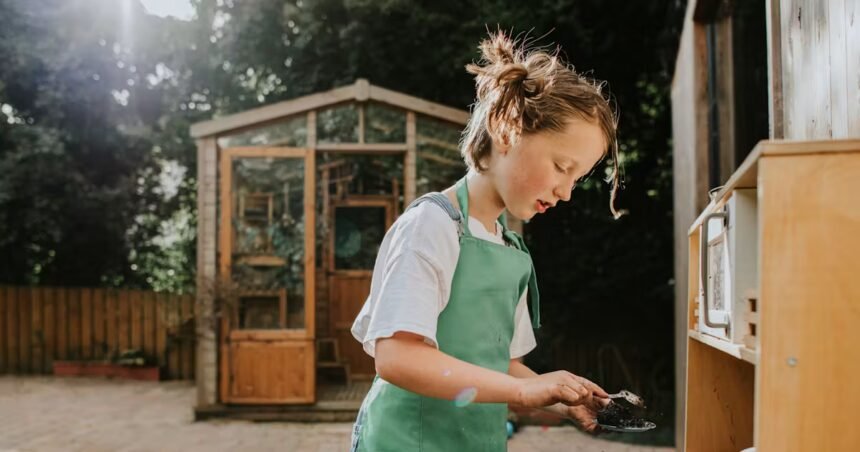
The conflict between protecting children and giving them independence is everytime It existed. You want them to be safe…but you also want them to be able to survive without you having to stay above them and make every decision. Knowing that your children can make wise decisions even when you’re not around can be a litmus test for whether you’ve done a decent job of parenting. Still, it’s not always easy to know exactly when you can test your teaching. This is especially true when deciding when to let your child play outside without you.
For many families in the suburbs or with privacy fences installed around clearly defined boundaries, there is no question of giving the children alone time outside. I know they are safe. However, there are other situations that require deeper thought and more concern. Our house is on the corner of the city. One of our streets is a boulevard. My yard is mostly fenced, but it’s not private and there are large gaps. More importantly, our daughter has never met a stranger.
But this is what I remember often. As a former apartment kid, I remember running around in rags from one end of the apartment complex to the other. We played roller hockey on the tennis court until long before dark. We vacationed at Barbie Beach, on the shores of the same lake where my father fished, but there were no parents in sight. And I’m still here. These memories begin at age 5 and continue through middle school.
So, when can children play outside by themselves?
“Children’s independent play is developmentally important, but it’s a parenting decision where everyone wants clear rules. Unfortunately, it doesn’t work that way,” says David Smith, educator and CEO of Silicon Valley High School. “There is no specific age to let your child have free access to outdoor or indoor play areas. You need to consider how your child will cope with independence and what your environment is like.”
So shouldn’t we trust a 7-year-old in our own backyard? Was he too young to wander? Or is she still too old to be so protected? It turns out there’s a lot more to consider than just the number of candles on her last birthday cake.
“At the age of seven, many children are able to go outside on their own for short periods of time, but a partially open urban garden is a different situation than a private, fully fenced garden,” says Smith. “If you have access to the road, you need to feel comfortable with it and get used to it. The best way is to assess the risks and explain to your child what is and is not allowed. Try short stretches in close proximity and increase as you both become comfortable.”
For us, security cameras are useful. Focusing on the backyard, we monitor the door where packages and groceries are delivered. It turns out it also includes some great shots of cars parked on the street and playsets in the backyard. We can hear and see almost everything. However, not everyone sees it that way. We also recognize that just because you have good visibility doesn’t mean you can act quickly when needed.
“Windows and cameras are useful for quick checks, but they’re just a backup,” Smith suggests. “Children need to be able to understand their limits: where they can go, what they can do, what to do if someone talks to them, and when to come back.”
Is there really “safety in numbers”?
I thought that being an only child was more of a problem for me than modern city life. I was always with a million friends in the apartment complex. Another time I was traveling in a group with all six of my rowdy cousins. Would I feel more secure if my child had a sibling or friend who could hold him accountable?I often remember my friends convincing me to do something stupid, but I don’t have the confidence.
Are numbers actually safe?
“Playing with other children can help, but it doesn’t guarantee safety,” Smith warns. “Sometimes kids take more risks when they’re together, because peer pressure is real. What matters is that kids understand the rules and stick to them even when they’re excited.”
Is maturity as important as actual age?
Smith says maturity should be as much a consideration as what the neighborhood is like, whether they have cameras, and whether the child has friends.
“When it comes to maturity, look for consistency over perfection,” advises Smith. “Do they follow directions? Do they check in as agreed? Do they come inside when asked? Are they generally aware of what’s going on around them? If they do these things most of the time, they can handle increased independent play outdoors.”
He also said that casting doubt on this milestone good What parents should do.
“Honestly, it’s a good sign that parents are asking these questions and thinking carefully,” Smith said. “Especially first-time parents experience everything more intensely. It’s okay to take it step by step and adjust as you go. That usually builds confidence. So when your child asks for it and shows signs of growth, set boundaries and let them out.”
Checklist to determine if your child is ready
Still looking for a simple checklist? Before letting your child play outside alone, ask yourself these questions:
- Do they talk to strangers?
- Do they understand the difference between a stranger and a trusted friend?
- Will they remember to check in at the arranged time?
- If I set a boundary, will it stay within that boundary?
- Are they relatively aware of what is going on around them when they are playing?
- Can they follow multi-step instructions?
- Are they vigilant around roads and driveways?
If your child is handling these things pretty well, it might be time to cut them some slack. That doesn’t mean you’ll be making your 5-year-old run around the entire neighborhood any time soon. However, it might mean letting them play in the garden on their own while you go to the bathroom or wash dishes near the window.
And what if they mess up? What if the next thing you know, they’re on the sidewalk chatting with a neighbor and a husky they’ve never talked to before? Or did he run out onto the road chasing a loose ball? After that, you may need to reevaluate. But you won’t know if they’re ready for it until you give them a chance to prove it.
Please take a deep breath. Believe that you were raised by a smart and mature child. and loosen the reins.