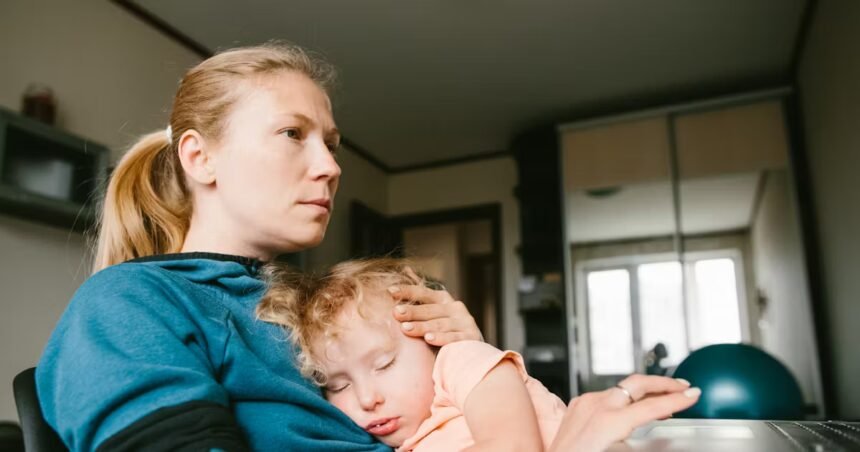
My toddler has a stuffy nose and a fever, so I canceled the sitter who was supposed to watch him during our virtual meeting. It would be rude to expose her to the cold.
That means I end up attending meetings with my toddler behind me. You have no choice. This is a meeting you can’t miss. Maybe he will sleep. Or just play quietly.
Wishful thinking.
By 1pm, he’s greasy and awake, so we take the meeting outside in hopes of spending an hour in some fresh air in nature. “Hello, I just wanted to let you know that my toddler will be standing in the background today,” I began. “He’s sick so we had to cancel the sitter.”
I’m sure it’s okay. Still, when my toddler started fussing at the 50-minute mark, I muted the microphone and my stomach knotted in a tight knot. It feels terribly unprofessional.
As a freelancer working from home, I often struggle with calculating sick days because my husband works in a school and doesn’t have easy access to insurance. I have a feeling that even if the positions were reversed, I would still make pediatrician appointments, play the role of nurse, and try to rearrange my schedule to work with a feverish toddler on my lap.
Is it biology? Social conditioning? What about how my kids instinctively look for me when they’re not feeling well? Or have I embraced the motherly role too strongly for my children to accept their father’s care in moments like this? Maybe that’s all.
I’m not alone.
A Genexa survey of 1,000 U.S. mothers found that 70% use their sick days to stay home when their child is sick, and 58% work from home while providing care. In other words, many of us are making the same impossible calculation of caring for sick children while continuing to work.
As mothers, we often blame ourselves for our children’s constant ailments: not giving them enough vitamin D, forgetting to wash their hands before meals, or letting them play in dirty play areas.
But the truth is, kids just get sick. a lot.
In fact, according to Mayo Clinic Press, children can get as many as 12 colds a year. And public health officials say this year’s cold and flu season is one of the worst in decades, meaning recovery times will be longer and mothers will have to cancel more child care.
We live in a system that requires caretakers, especially women, to “absorb impossible demands,” says clinical psychologist and executive coach Anne Welsh. “Mothers are asked to be mothers so as not to work, and to work as not to be mothers…It is an impossible bondage.”
I wanted to understand why things like this keep happening and why this feels so personal, so I turned to an expert.
Why am I sorting everything?
The often unspoken cultural belief is that mothers are better caregivers, but the Welsh told us:
Mothers who think this way are more likely to seek flexible work. “Over time, that flexibility becomes the basis for why they should intervene again,” she says.
Parents also cling to the idea that a sick child should be put to bed, fed homemade soup and have a doting mother nearby, added clinical counselor and parent educator Dawn Friedman. But throughout history, parents have had to work, but that hasn’t doomed their children.
what have However, it is the mother’s sense of fairness that suffers.
“Mothers are asked to be mothers so as not to work, and to work so as not to be mothers.”
Olivia Bergeron, a psychotherapist and parent coach, says parents rarely have clear conversations about who will be responsible for caring for the child. Mothers step up, she says, but this is often accompanied by resentment toward their partners, guilt at being a distracted employee, and shame at not being able to “do it all.”
Bergeron shares a familiar mental loop. It’s so unfair that my partner didn’t even offer to stay home. after that: What mother wouldn’t want to stay home with a sick child? And finally, I am a terrible mother for having these thoughts and feelings.
So what’s a mother to do?
Make a “proactive” plan – have the conversation in front Bergeron recommends that the illness raises questions about who is home, how work will be handled, and what backup options are available. She emphasizes that fathers are capable caregivers and should create a plan that respects both their parents’ work and well-being.
For single mothers without backup care, that means sick days are that much more isolating and exhausting. Bergeron recommends getting creative by identifying potential helpers within your community, such as family, friends, babysitters, or even nannies borrowed from other families.
And then there are the realities that we have to find workarounds for.
Trying to work from home with a sick child is a special kind of hell.
Very few things are simple. You pick up your kids early, take them to the pediatrician, pick up their medication, and still get a call to get home in time for a Zoom board meeting at 3 p.m.
How can I do that without losing my mind?
Remember what sustains you, says parenting coach and holistic therapist Blanca Molnar. That might look like a playlist of your favorite songs, moving your body, drinking a good cup of coffee or tea, writing in a journal, or taking deep breaths to calm your nervous system. Molnar says these small micro-moments of joy ground us and help us stay calm.
It’s also appropriate to set boundaries around your work and let them know that you have limited availability on sick days. Instead of working to exhaustion, she recommends focusing on one task at a time.
Perhaps most importantly, lower your expectations for a day like this. “Start with yourself. If you try to hold yourself too rigidly to high standards, you’ll break,” warns Molnar.
If you use up all your paid vacation, you can also get sick.
This is a common scenario. She nursed her child back to health, only to become infected with the bug herself.
The risk is even higher for parents with chronic illnesses such as cancer, diabetes, and heart disease. Three out of four American adults have at least one chronic disease, many rely on medications that weaken their immune system, and a simple cold can cause them to miss weeks of work or even be hospitalized.
Hilary Hodge, a mother living with two illnesses, knows this reality first-hand. She now teaches parents how to reduce their chances of getting sick.
Her advice includes:
- Please ask children to wash their hands as soon as they get home.
- Wearing a mask during close contact if the child has an ongoing illness
- Encourage kissing the hair or back of the head instead of the face
- Run an air purifier with a HEPA filter and open windows if the weather is nice.
But even if you’re doing everything “right,” you can still get sick. Then, just as you begin to recover, another family member comes down with a new and troubling illness.
You can’t win, right?
That’s the point.
Cold and flu season is “an expanded version of being a working mom all the time. The ambitious paradox of wanting to excel in both areas while operating in a system that isn’t set up for that… There’s no luxury. There’s just constant triage,” says Wales.
Children will continue to get sick. Future meetings will continue to be scheduled. And somewhere, another mother will be doing the impossible calculations of a working mother, muting her microphone while her feverish toddler fusses by her side.