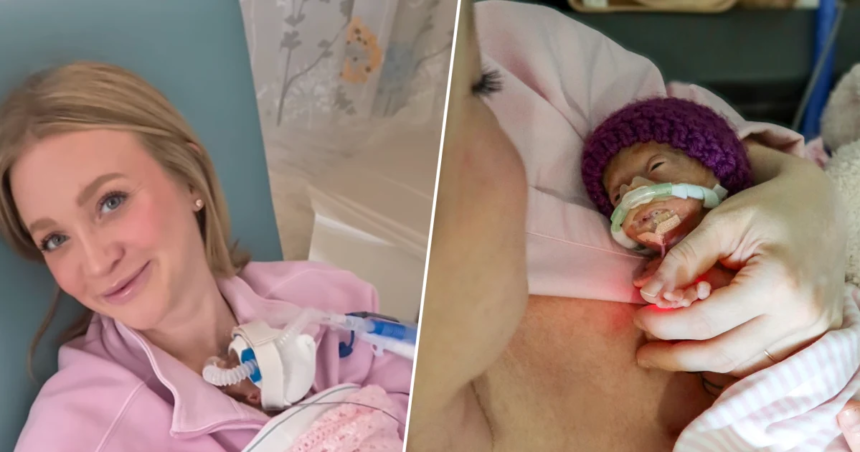
Doctors kept telling Taylor Plemmons throughout her pregnancy that she would likely lose the baby she was carrying. But she didn’t believe them.
“It sounds probably cuckoo, but I just I knew that she was going to be OK,” Plemmons tells TODAY.com.
“As I would leave these appointments, I was being told, ‘We’ll probably lose a heartbeat before you’re back at the next appointment,'” she shares. “I just kept telling my husband, ‘I don’t accept that. That’s not going to be our story.'”
Plemmons was right — that was not their story.
Prayer gave the young mom a sense of peace, and following a harrowing hospital stay, baby Margot Louise Plemmons was born at 29 weeks, 1 day gestation on Jan. 12. She weighed just over 1.7 pounds.
Though the journey to growing her family has been rough, Plemmons has shared her story on social media. Her video of the first time she was able to hold Margot has resonated with viewers, receiving more than half a million likes.
“Fertility and secondary infertility look so different” for everyone Plemmons says, and many families keep their struggles private. She shares her story online, as difficult as it may be, as “a reminder that you don’t know what people have to go through to grow their families.”
Plemmons and her husband Austen had no idea how blessed they were to have a smooth pregnancy and delivery for their older daughter, Scottie, now almost 2.
After Scottie’s birth, Plemmons had three miscarriages, and even after “a million tests,” doctors couldn’t understand why the seemingly healthy mom was having difficulty.
Turned off by Facebook support groups that highlighted sad stories, Plemmons began sharing her struggle on social media as a way to reach out to other women and form a community.
“When I had my first, I was just so, I guess, naive about it,” she says. “I was grateful, but not really. I didn’t understand what a blessing — a miracle — it was to be able to just have a smooth pregnancy deliver full term.”
Even this most recent pregnancy was “rough” for Plemmons.
At 10 weeks, doctors discovered that Plemmons had a large subchronic hematoma that caused her to hemorrhage. She had three more hemorrhages throughout the pregnancy. Each time, she feared that she was losing the baby.
At 19 weeks, doctors measured the baby and learned that she was severely growth restricted. The following week, Margot was measuring below the 1st percentile of similarly aged babies. At 23 weeks, Plemmons was admitted to the hospital, where she and Margot were monitored regularly.
“They just kept saying we were going to lose her, and that we would not get to have a child at our side again,” Plemmons recalls. “It was awful.”
During her weeks in the hospital, Plemmons listened to worship music, and she spent quiet time reading and protecting her mental health. “I was absolutely terrified. I could not fathom losing another child,” she says.
In the meantime, she also worried about her daughter Scottie, who was still too young to understand what mom was doing in a hospital room.
“It was just really hard on our family,” Plemmons says.
Doctors decided to deliver the baby when Plemmons’ preeclampsia developed into HELLP syndrome, a life-threatening pregnancy condition when red blood cells break down, liver enzymes are elevated and platelet count is low.
“They told me to save my life and baby’s life, I had to have her,” Plemmons says.
In the days following Margot’s birth, however, Plemmons says, “I honestly think I was so disassociated. I couldn’t process what was happening. I was looking at her in the isolate, but it wasn’t sinking that I had had her and that this was our reality now.”
The biggest concern for a baby born so early and so tiny is lung development. Plemmons says Margot has been doing “very well” on the lowest settings of a CPAP machine. The NICU staff is also working on increasing Margot’s weight.
“They all laugh and joke how feisty she is,” Plemmons shares. “You try to mess with her, and she’ll start swinging. She’s definitely got a little personality, and she’s hanging in there.”
So are her parents.
Still recovering from weeks of physical and emotional stress, Plemmons was finally able to hold her tiny daughter on Day 5 of her life.
“It was the most incredible moment,” Plemmons says while holding back tears. “It’s just been so hard to really want to grow your family and have a second child, and to love her so much — and then to just be so scared. If love could save them, we would.”
She continues, “When I finally got to hold her and just feel her body breathing, for the first time in a really long time I just breathed, I exhaled.”
For now, the Plemmons family visits Margot in the NICU as much as they possibly can. It will be a long few months until the baby will gain enough weight to be stable enough to leave.
“It’s going to be really hard to put weight on her because her body is prioritizing her brain and her heart, and it’s been in survival mode for so long it doesn’t quite know how to put on weight like a normal preemie would,” Plemmons explains.
Margot’s prognosis seems promising, but each day in the NICU can bring a new set of challenges. Though it’s rare for the mom of such a delicate baby to share public updates, Plemmons appreciates having social media as an outlet, especially when she communicates with women who are in similar situations.
“Even though we don’t want to be in this club, we are,” she says. “So we’re just trying to make the best of it.”