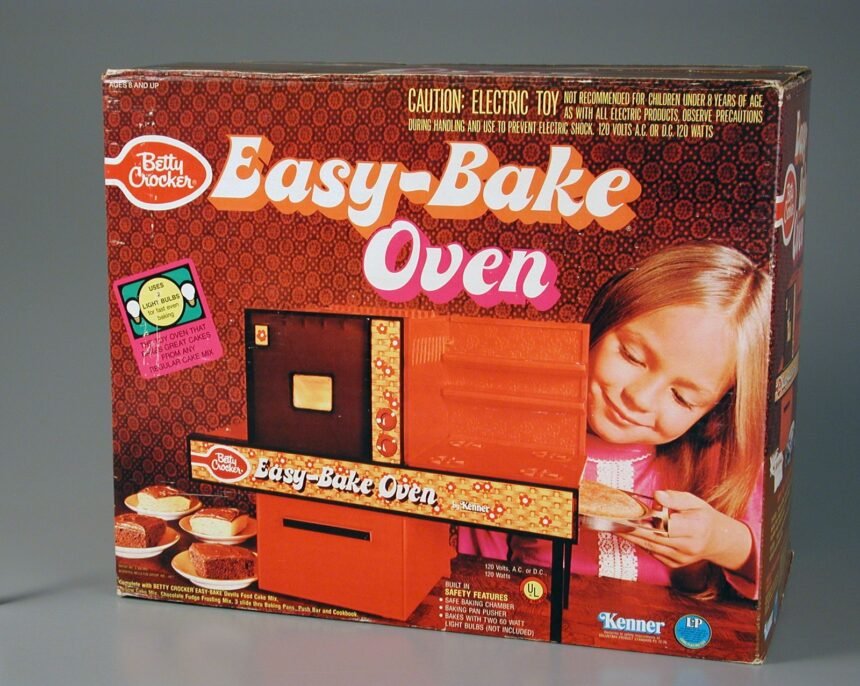
The story of the Easy-Bake Oven begins with pretzels. In the early 1960s, Norman Shapiro was walking through New York City when he spotted vendors keeping pretzels warm with small ovens. Shapiro was the executive sales manager at the toy company Kenner Products.
Inspired by the vendors, he later took the idea to his colleagues at Kenner. There, James Kuhn, vice president of research and development, worked alongside Ronald Howes, director of research and new product development. The team designed the Easy-Bake Oven, a light bulb-powered functional toy oven that allowed children to emulate their parents and make their own cakes and cookies. Kenner debuted the product in 1963.
“That’s what makes inventors so smart,” says Ed Sobey, author of The Way Toys Work. “They can make that connection; they see something with the left side of their brain and transport it to the right.”
The Easy-Bake Oven was an instant best-seller. “Around 500,000 were sold in its first year,” says Debbie Schaefer-Jacobs, curator at the Smithsonian’s National Museum of American History in the division of home and community life. This was despite the fact that it cost $15.95, a huge price for a toy at the time, and the equivalent of more than $160 today. Demand for the Easy-Bake Oven was so high that Kenner tripled its production in 1964.
More than 60 years later, the toy has been relaunched by its current owners, the toymaker Hasbro—which took over production in 1991—and Just Play. “Few brands hold the iconic status and enduring appeal of Easy-Bake,” said Hasbro’s Bradley Bowman in a September statement. For sale exclusively at Walmart, the toy reportedly sold out at stores across the country during the holiday season.
The oven, originally marketed to young girls, was released at a time when middle-class American families were interested in technology. Not only did 90 percent of homes have a television by 1963, but electric freezers, refrigerators, frozen dinners and boxed foods had become hugely popular. Soon after the Easy-Bake Oven was released, Kenner put out various mixes for cakes, cookies, pies and other treats, which were released in polyethylene-coated aluminum foil packets that gave them a shelf life of two years.
During the Victorian era, though, working-class children were treated more as “miniature adults,” says Schaefer-Jacobs. They were expected to contribute money to the family by working dangerous jobs in factories and as chimney sweeps from as young as 7 years old. “It wasn’t until around the 1880s that the idea of child psychology emerged and children were treated as children,” she adds. “That’s when doll houses become very popular as toys for kids, who use them to play make believe, which helps to prepare them for life as adults. Children love to pretend to act like their moms and dads, take on their roles, and figure out how to do it themselves.”
Knowing that the product would prove just as appealing to parents looking to buy their kids presents as well as the children themselves, Kenner “would run Easy-Bake Oven commercials during children’s morning cartoons and during programs like ‘I Love Lucy,’” says Michelle Parnett-Dwyer, curator at the Strong National Museum of Play in Rochester, New York. Kenner’s slogans for the oven included “Just like mom’s—bake your cake and eat it too!”
This advertising campaign turned what was a “mundane household task into something that was playful,” explains Schaefer-Jacobs.
Fun fact: A museum dedicated to enjoyment
The Strong National Museum of Play is an institution that chronicles the history and impact of toys, games and other forms of play.
The museum notes that it “houses the world’s largest and most comprehensive collection of historical materials related to play.”
The Easy-Bake Oven represents an evolution from the toy kitchens of the past. As far back as the 17th century, kitchens were found in German doll houses. Parnett-Dwyer told the Washington Post last year that these toys introduced young girls to the domestic labor that “would be expected of them as they grew older” and would also be used to train staff how to run a kitchen.
Then in the late 1800s, tiny versions of full-size stoves were created. Experts still “aren’t entirely sure if these were toys or if they were used as samples by salespeople to give demonstrations,” says Parnett-Dwyer. “Especially as they were often made with cast iron, which was very heavy and dangerous.”
Later, the corporations Western Electric and Lionel Corporation debuted potentially hazardous toy electric stoves in 1915 and 1930, respectively.
Todd Coopee, the author of Light Bulb Baking: A History of the Easy-Bake Oven, said it was Kenner’s use of light bulbs as a heating source that set the Easy-Bake Oven apart. “By using conventional light bulbs, something kids were around every day, they were able to convince parents the toy was safe—even though it got up to 350 degrees Fahrenheit inside the oven, which is a pretty standard baking temperature,” he told Gizmodo in 2014. “Kenner wanted to call it the Safety-Bake Oven, but one of the regulatory bodies in charge of print and radio advertising told them, ‘No, you can’t do that, because it implies a safety track record you haven’t achieved yet.’”
Kenner’s Easy-Bake Oven was made with plastic, which had become increasingly popular with toy companies after World War II. That ensured that its temperatures didn’t reach the level of some of its toy oven predecessors. But burn risks could not be eliminated. In 2007, Hasbro issued a major recall of its newly designed front-loading oven, as children reportedly got their hands caught inside them and suffered burns. In one case, a 5-year-old burned her hand so severely that her finger had to be partially amputated.
Despite other toy companies following Kenner’s light-bulb approach, such as Topper Toys’ Suzy Homemaker oven in 1966, the Easy-Bake Oven ultimately dominated the market so convincingly that it became the de facto name for the toy. “Girls when they become mothers get one for their daughters, and it just becomes each generation passing it down to the next,” says Sobey.
Since its inception, updated versions of the Easy-Bake Oven, with and without the bulb and with new colors and designs, were regularly released, and in 2006, the product was inducted into the National Toy Hall Of Fame. More than 23 million ovens have been sold.
As Sobey says, “Continually changing and innovating helped the Easy-Bake Oven hold its own.”