- Research shows that young children who are better at detecting musical rhythms are also better at recognizing patterns in sounds, an important skill for language learning.
- Contrary to popular opinion, parents’ own musical ability does not predict their baby’s rhythmic skills, a study has found.
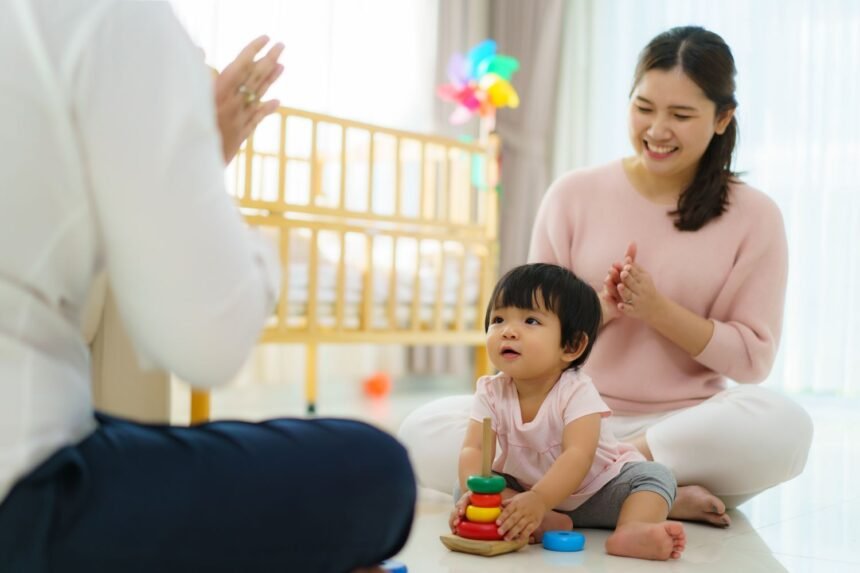
- Babies benefit most when parents actively sing, clap, and make music together.
For thousands of years, parents have sung lullabies to calm their children and help them fall asleep. But research shows that singing to your baby doesn’t just calm them down, it may actually help prime their brain for learning language.
Dutch researchers found a link between the way infants process musical rhythm and the way they process language. Research published in journals developmental scienceshowed that babies who are better at sensing the rhythm of music are also better at understanding patterns in sounds, an important skill for learning words.
Experts say the relationship makes sense.
“Music and language are both built on patterns. Just as speech organizes syllables into words, music organizes beats,” says Jordyn Coveleski Gorman, a pediatric speech-language pathologist, child development specialist, child nutrition specialist, and founder of the online resource hub Eat Play Say. “So if a baby’s brain is good at finding and tracking patterns in sounds, that skill can also be useful for early language learning.”
Dr. Rachel Albert, professor of psychology at Lebanon Valley College and director of the LVC Baby Lab, said the findings highlight the inherent strength of babies.
Dr. Albert said, “Babies are innate pattern detectors, and this study highlights the similarities between music and language. Both music and language contain highly patterned sounds.”
window into your baby’s brain
This small study involved 44 infants aged 6 to 9 months. To find out how their brains responded to sound, the researchers used an EEG cap, a safe, non-invasive cap that measures brain activity.
“EEG research in infants is always difficult because the infants have to wear a hat with electrodes and cables attached to their heads during the session,” explains study lead author Iris van der Ulp, a doctoral candidate at Utrecht University. To keep the young children comfortable and prevent them from pulling on wires or moving too much, the researchers had the babies sit on their parents’ laps and provided toys to keep their hands occupied.
Infants heard two types of sounds. One was a series of made-up words with no pauses, designed to repeat certain syllable patterns like words. The other consists of rhythmic musical patterns. The researchers then determined whether the infants’ brain activity was in sync with these patterns.
“Infants who accurately synchronized their brain waves to the rhythmic beat of music also accurately synchronized their brain waves to the words of an artificial language,” van der Wolp said. “This shows that there is indeed an overlap in how young children process music and language.”
Do your musical skills predict your baby’s abilities?
The study also busted a common misconception.
“It has long been proposed that musical rhythmic abilities are genetically inherited,” van der Wolp says. “However, we found no evidence that this is the case.”
What mattered was how often parents and babies participated in music together. Infants whose parents reported that they frequently participated in musical activities together showed stronger rhythmic skills, which led to improved language skills.
“Based on these results, I encourage parents to spend time making and listening to music with their children, as our results show that this may be beneficial for both children’s musical and language development,” says van der Ulp.
Gorman added that the discovery that parent and child musical activities are more important than the caregiver’s own skills is significant and empowering for families. “It doesn’t have to be musical. It doesn’t have to be on-key singing,” Gorman explains. “They just need to be willing to sing, clap, jump, and play around with their baby.”
Jordyn Coveleski Gorman, Pediatric Speech-Language Pathologist
It doesn’t have to be musical. You don’t have to sing in key. All you need to do is be happy to sing, clap, jump, and goof around with your baby.
— Jordyn Kobeleski Gorman, Pediatric Speech-Language Pathologist
Why is it important to engage musically with your child?
Simply playing music in the background is not the same as making music together. According to Gorman, what really supports early learning is interaction.
“That shared engagement is just as important as the rhythm itself,” she says. “When parents sing with their babies, they slow down the words, exaggerate the sounds, use repetition, and combine sounds with movement and facial expressions. All of these things help the baby’s brain organize the words and begin to understand them.”
Timing and alertness are also important, says Dr. Albert. Babies learn best when sounds are associated with what they’re focused on in the moment, whether it’s music or sounds.
“Imagine a toddler playing with building blocks,” says Dr. Albert. “Parents responding to babbling on the blocks with words or songs related to what the toddler is doing will support learning more than talking about other activities the toddler can do or talking nonstop about the blocks.”
What these findings mean (and what they don’t)
So should you enroll your child in a music class? Not necessarily.
“What I really want parents to take away from this is not that I need to start formal music lessons with my son at 6 months old, but that the routines he’s already doing are actually important,” Gorman says. “Singing during diaper changes, clapping during playtime, bouncing during songs, and making up silly chants during bath time – these things make developmental sense. We value connection over perfection. If you’re interacting with your baby, talking, singing, playing, and responding, you’re already doing a lot to support your baby’s language development.”
She also cautions parents against reading too much into any single study. Although the study shows a link between rhythm skills and language learning, “just because babies aren’t really interested in music doesn’t mean they’re going to struggle with language,” she says. “Development is not black and white. Babies have different strengths and many paths to developing strong language skills. Rhythm may be one helpful piece of the puzzle, but it’s not the whole picture.”