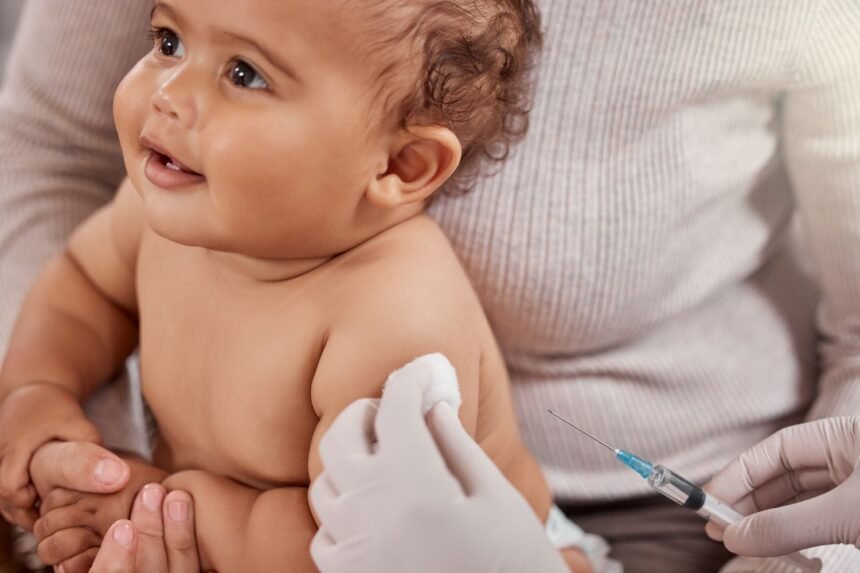
- Measles outbreaks are increasing and infants under 12 months of age are particularly at risk because vaccination is not yet fully covered.
- MMR can be given early to infants between 6 and 11 months of age in endemic areas or before travel to enhance preventive measures.
- You can help keep your baby safe by talking to your pediatrician and making sure your family members are vaccinated.
Over the past two years, the United States has experienced an unprecedented number of measles outbreaks. In 2025, there were 49 confirmed measles outbreaks, and just two months into 2026, the CDC reported five new measles outbreaks. Compare these numbers to 2024, when a total of 16 measles outbreaks were recorded, and you can see why public health officials and many parents are concerned.
Measles is a mild illness, but for some children it can cause pneumonia, encephalitis, and death. Thankfully, the measles vaccine is highly effective and safe. The problem is that infants usually cannot be vaccinated until they are 12 months old.
This leaves parents of infants under 12 months old living in endemic areas with many questions and concerns. How can I protect my baby from measles if he is too young to be vaccinated? Can my baby receive the measles vaccine early?
We can help. We connected with pediatricians to help them understand the options available to babies who are too young to receive the measles vaccination.
When is early vaccination a good option?
Measles vaccine is given as part of the measles, mumps, rubella (MMR) vaccine. Both the Centers for Disease Control and Prevention (CDC) and the American Academy of Pediatrics (AAP) recommend that children receive two doses of this vaccine. The first time is between 12 and 15 months of age and the second time is between 4 and 6 years of age. This vaccine sequence provides 97% protection against measles infection.
However, due to recent surges in measles outbreaks in various parts of the country, the AAP recently issued some new guidance.
“It is recommended that infants 6 to 11 months of age who live in, travel to, or travel internationally to receive their first dose of MMR,” says Dr. Ellen Fitzpatrick, a board-certified pediatrician with Pediatrics Medical Group. “If your young child is traveling, this must be done at least two weeks before the trip.”
Importantly, this early dose does not count toward the overall two-dose MMR recommendation. “Your child should be vaccinated between the ages of 12 to 15 months and 4 to 6 years old,” says Dr. Fitzpatrick.
She recommends parents visit the AAP to learn more or talk to their pediatrician or family doctor about their options. So what happens if your baby under 12 months doesn’t live in an area where measles is endemic?
“Prophylactic vaccinations are not necessary if the likelihood of imminent infection is low (no travel or local outbreaks),” says Dr. Molly O’Shea, a pediatrician and AAP spokeswoman.
Dr O’Shea explains that the MMR vaccine provides short-term, weak protection when given between six and nine months of age, and may slightly reduce your baby’s immune response to subsequent MMR vaccines.
“For these reasons, it makes sense to wait until your baby is at the recommended age for vaccination, unless your baby is in an endemic area or has traveled internationally or to an endemic area,” she says.
Are there any downsides to early vaccination?
The reason it is currently recommended that infants receive their first MMR vaccine at 12 months of age is because the vaccine is less effective in younger infants.
“The main concern with early vaccination is that interference from maternal antibodies may reduce vaccine efficacy,” explains Shilpa Singh, M.D., clinical director of pediatrics at St. Anthony’s Hospital.
That’s why vaccination earlier than 12 months doesn’t “count” toward your child’s MMR vaccination requirements, explains Dr. Charles Hannum, a general pediatrician at Tufts Medical Center.
“I usually talk about this as an ‘early and booster’ dose of measles vaccine,” he says. “It’s less effective at producing antibodies if given early. It’s still effective, but not as good as when given to older age groups. That’s why the first dose is recommended at one year of age.”
Some parents may be concerned that receiving the MMR vaccine before 12 months of age may be dangerous for their baby. But Dr. Hannam assures parents there’s no need to worry.
“Measles vaccine is generally safe if given early in infants, and side effects are similar to other measles vaccinations,” he explains.
What other steps can parents take to protect their babies during a measles outbreak?
Early vaccination is not the only way parents can protect their young babies during a measles outbreak.
Here are some tips from Dr. Fitzpatrick.
- Protect your baby with close contacts and family members whose measles vaccination status is up to date.
- Avoid crowded places such as shopping malls and daycare centers where outbreaks are known.
- If your baby has measles, act quickly. If the age is appropriate, babies can receive MMR within 72 hours of exposure.
- Babies under 6 months of age cannot receive vaccines, but they may be eligible for measles immune globulin if they were exposed to measles within 6 days.
- Be aware of the early symptoms of measles, such as fever, cough, rash that starts in the hairline of the face, canker sores, and Koplik spots.
- If you develop symptoms of measles, isolate yourself immediately. Before visiting the clinic or emergency room, call your pediatrician for further guidance.
Do my parents and grandparents need a measles booster shot?
Whenever possible, you want to make sure that the people caring for your baby have immunity to measles, especially during an outbreak. You may be wondering whether you, your partner, grandparents or extended family members need a measles booster.
Most adults have immunity to measles, but there are exceptions. The majority of adults born before 1957 were infected with measles as children and are immune. Dr O’Shea said some adults born between 1957 and 1988 may have only received one dose of MMR and could benefit from a second dose.
“If you are concerned, you should get the vaccine at your local health department or pharmacy,” Dr. O’Shea recommends. “Don’t wait until there’s an epidemic.”
Where should I go if I have more questions about the measles vaccine?
It is common and completely understandable to have many questions and concerns about the health and safety of your baby during a measles outbreak. These questions can be difficult to resolve, but help is available.
“The United States is currently experiencing a nationwide measles outbreak, making it increasingly difficult for communities to respond,” Dr. Hannam said.
He recommends contacting your local public health department to see if early administration is the right course of action for your baby.
“In many cases, single cases of measles, or isolated cases, are tracked very closely by public health agencies, so public health agencies are best equipped to know the risk to the general population,” he says.
If you have any questions, don’t hesitate to ask your child’s pediatrician. “Always talk to your pediatrician with any questions or concerns. Your pediatrician will be able to advise you on what’s best for your baby,” concludes Dr. Hannam.