In summary
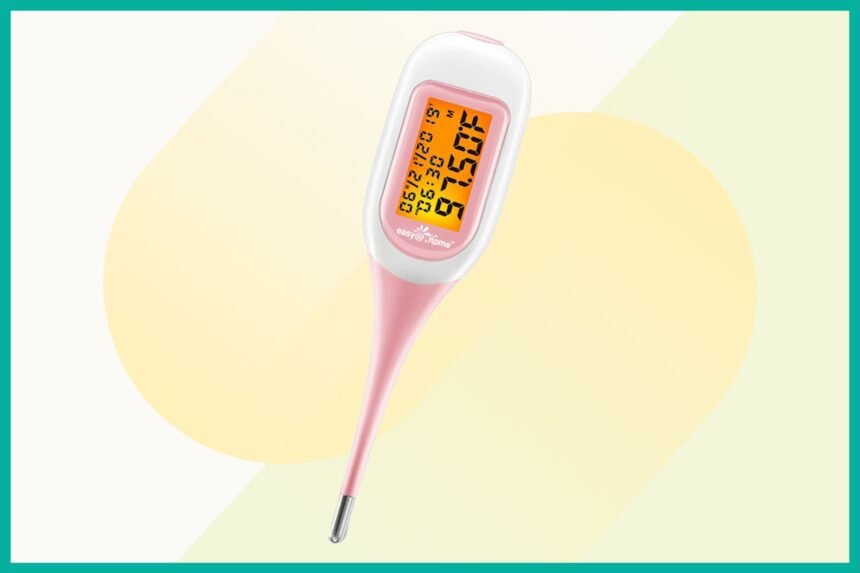
If you are trying to get pregnant, measuring your basal body temperature can help you determine when you are most likely to get pregnant. We consulted with medical experts to find the best basal thermometers on the market. We chose the Easy@Home Smart Basal Thermometer as the Best Overall Award and the iProven Digital Basal Thermometer as the Best on a Budget Award.
If you are trying to conceive, it is important to determine when you ovulate. There is a lot of data you can collect about your menstrual cycle to pinpoint your fertile days and increase your chances of conceiving. For example, you can track your menstrual cycle and cervical mucus, or use an ovulation predictor kit to detect increases in luteinizing hormone (LH). Tracking your basal body temperature (BBT) can be helpful as it allows you to identify the slight increase in BBT that occurs during ovulation.
“Tracking your basal body temperature patterns can help you understand if you’re ovulating regularly,” explains Sydney Chan, MD, FACOG, founding partner and medical director of CCRM Fertility in Austin. “If you have a regular menstrual cycle, it is possible to predict your fertile window, which is the five days leading up to ovulation and the day of ovulation.”
To create this list of recommendations, we consulted experts about the relationship between BBT and fertility, and what to look for in a thermometer. “When choosing a basal thermometer, look for one that measures in 100-degree increments and is specifically designed for this purpose,” notes Dr. Chan. “Digital displays are important for accuracy and ideally can be combined with an app that enables consistent tracking over time.” We evaluated the top products on the market for ease of use, accuracy, and value.
What is basal body temperature?
“Basal body temperature refers to the reference temperature that your body reaches at rest, so it should be measured first thing in the morning, before you get out of bed,” points out Dr. Chan. BBT changes slightly during the menstrual cycle. “Core body temperature increases due to the release of progesterone that occurs after the egg is released during ovulation,” says Dr. Chan. “Average basal body temperature is 97 to 97.5 degrees Fahrenheit before ovulation and 97.6 to 98.6 degrees Fahrenheit after ovulation.” Basal thermometers are more accurate than traditional thermometers and detect even the slightest fluctuations.
our review process
To choose the best basal thermometer, we first reviewed the National Institutes of Health (NIH) guidelines regarding the relationship between basal body temperature and fertility tracking. We also spoke to experts, parents Provide your staff with detailed information on how to use basal thermometers and get personal product recommendations. When evaluating products, we considered accuracy, response time, ease of use, and overall value.
our experts
The following experts provided insight into basal body temperature tracking and the features they look for in a thermometer.
- Sydney Chan, MD, FACOG, founding partner and medical director of CCRM Fertility of Austin. She is dual board certified in reproductive endocrinology, infertility, and obstetrics and gynecology.
- Nicole A. Sparks, MD, Atlanta-based obstetrician-gynecologist
Factors to consider in basal thermometers
- Ease of use: To accurately track your basal body temperature over time, you should measure it every morning as soon as you wake up. You can set an alarm to remind you or use a wearable thermometer that automatically takes your temperature at the correct time. For manual thermometers, look for a large, easy-to-read display screen with large numbers and a backlight. Bluetooth is also a useful feature. This means the device can sync with relevant apps and record measurements automatically.
- Response time and comfort: Most basal thermometers take longer to provide a reading than traditional thermometers. The reading is expected to take approximately 1.5 to 2 minutes. That’s why a comfortable tip is another important feature to look for in a manual thermometer. It is placed under the tongue for two minutes each morning. For wearable products, look for soft fabrics that aren’t too constricting.
- value: Manual thermometers are generally affordable and reliable options. Some products have features such as Bluetooth, large memory storage, and reminder notifications that can be a little more expensive. Wearables can be quite expensive, but they take away most of the headaches that come with the process of temperature tracking.
Where should I place my basal thermometer?
A manual basal thermometer is placed under the tongue. Wearable devices are typically worn on the upper arm. Newer wearable products are also appearing on the market, such as bracelets, watches, and rings. Smart rings like the Oura Ring, Femometer Cyra, and Evie Ring are all the rage, but the jury is still out on their reliability in accurately predicting fertility. However, it may be better to measure your wrist rather than your fingers. “Wearable basal thermometers measure skin temperature, which can fluctuate depending on environmental temperature and is usually lower than core body temperature,” explains Dr. Chan. “Many patients find the Oura ring helpful because it automatically tracks skin temperature trends throughout the night and can be synchronized with Natural Cycles for further insight into fertility.”
How is a basal thermometer different from a traditional thermometer?
Basal thermometers work basically the same way as traditional thermometers, but they are much more sensitive. Basal thermometers can measure up to 1/100th of a degree to capture small temperature fluctuations that may occur over the course of a cycle. Dr. Chan says stress, medications, illness, alcohol consumption, sleep disorders, and changes in environmental temperature can all affect BBT. Basal thermometers are not 100% accurate and are not the only way to predict ovulation.
If I have irregular periods, can I use my basal body temperature to predict whether I’m fertile?
Not all basal thermometers are made with menstrual irregularities in mind. People with polycystic ovary syndrome (PCOS) or those with irregular periods whose cycles fall outside of the typical 23-35 day period may find that basal thermometers are not designed to provide accurate assistance. “While basal body temperature can help confirm ovulation, it is not a positive predictor of when you are likely to get pregnant,” explains Dr. Chan. “Therefore, for women with irregular menstrual cycles, it is best combined with methods that detect surges in LH (luteinizing hormone).”
who are we
Olivia Campbell is the editor. parentsan experienced journalist and essayist, and mother of three boys. She also new york times bestselling author of Women in white coats: How the first female doctors changed the world of medicine and Sisters in Science: How four female physicists escaped Nazi Germany and made scientific history.